Stay Updated With Tips , Guides And News On Ev Batteries , Charging And SustainableEnergy
MAPPING INDIA'S EV CHARGING GUIDELINES
INTRODUCTION
India is among the handful of countries that support the global EV30@30 campaign, which aims to have at least 30% of new vehicles sold be EVs. (Source) Developing a widespread EV charging infrastructure will be fundamental in ensuring the seamless integration of EVs into the transportation landscape.
Government initiatives, incentives, and regulatory frameworks will not only improve the affordability of these vehicles, but also entice third-party players to invest in building and maintaining EV charging infrastructure
Regulatory Frame Work For EV Charging
In India, EV industry regulation falls under the purview of the Ministry of Power and the Ministry of Heavy Industries and Public Enterprises. Central and State governments come together to create and implement policies for setting up charging stations, licensing, tariff regulation, and quality control
FAME - Scheme
The FAME II scheme is one of the most significant schemes implemented by the Indian Government that focuses on boosting widespread EV adoption and addressing the challenges in the ecosystem. The scheme introduced several incentives for EV manufacturers and consumers, along with support for creating charging infrastructure.
Under phase I of the scheme, the Ministry of Heavy Industries sanctioned 520 Charging Stations nationwide. In phase II, this number went up to 2,877 charging stations in 68 cities across 25 states and Union Territories, and 1576 charging stations across 9 Expressways and 16 Highways.
In addition, the Goods and Services Tax (GST) on chargers and charging equipment has been reduced from 18% to 5%, further incentivising the adoption of EV equipment and in turn making adoption of EVs more lucrative. (Source)
Guidelines For EV Charging In INDIA
The Ministry of Power has issued guidelines and standards for charging infrastructure for electric vehicles to enable faster adoption of EV policies in India. Here are the key excerpts from the document:
1 You can charge your vehicle at your home or office residence using your existing electricity connections.
2 Anyone can set up public charging stations, provided the stations meet the technical, safety, and performance standards set by the Ministry of Power, Bureau of Energy Efficiency, and the Central Electricity Authority.
3 Public Charging Stations intending to apply for an electricity connection must submit a complete application to the Electricity Distribution Company licensee. Following this, the Distribution Company must provide the electricity connection for the said PCS within 30 days at maximum.
4 Public Charging Stations can obtain electricity from any distribution company through open access after paying the applicable surcharge
Technical Aspects Of Ev Charging In Infrastructure
Electric Vehicle Supply Equipment (EVSE) forms the core of EV charging infrastructure. It takes power from the local electricity supply and through a control system and wired connection safely charges electric vehicles.
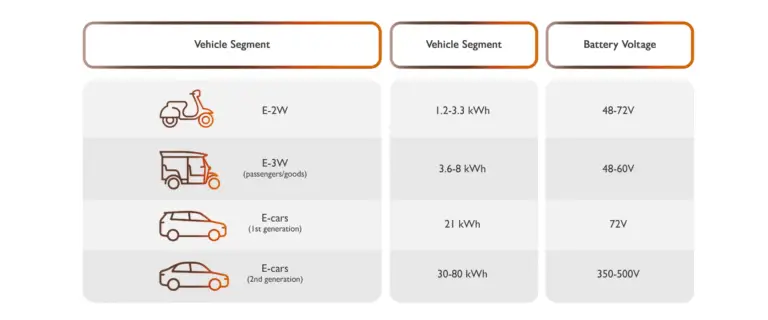
EV charging depends on its battery specifications, as power must be supplied to the battery at the right voltage and current levels for safe charging. The table given below shows the battery capacities and voltage among different EV segments
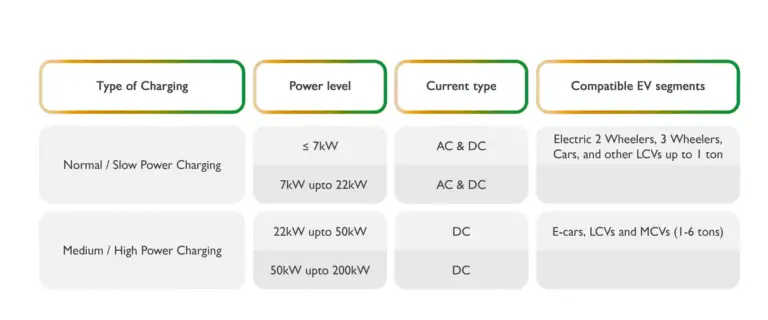
EVSEs have different power ratings or levels based on charging requirements, which in turn determine the input power requirements for charging infrastructure.
Charging methods and Power ratings specified for Electric Vehicles Supply Equipment (EVSE) are as follows:
Conclusion
To promote the growth of EV charging infrastructure, the Indian government has enacted various policies. The electric vehicle industry has seen significant investment, climbing from about $6 billion at the beginning of the year toward a projected $20 billion by 2030. However, this new infrastructure must be adapted through customized policies to fit India’s unique transportation needs
Selecting the right EV battery is critical for performance, safety, and cost savings. From battery capacity and warranty to charging speed and eco-friendliness, there are key factors every EV owner should evaluate. This guide breaks down what to look for so you make the best choice for your vehicle
2.EV Battery Charging Tips for India?
Charging habits play a huge role in the health and performance of your EV battery. From avoiding overcharging to choosing the right charging stations in Indian conditions, these tips will help you extend battery life, improve efficiency, and ensure safe, reliable performance on every journey
3.Best EV Batteries for 2-Wheelers in 2025?
Explore the top battery technologies powering India’s electric two-wheelers in 2025—from affordable Li-ion and high-life LFP packs to breakthrough solid-state and modular swapping solutions. Whether you’re looking at range, safety, or cost, this guide highlights the latest trends and what makes each option stand out